





































The Role of Plastics in Bangladesh’s Industrial Growth

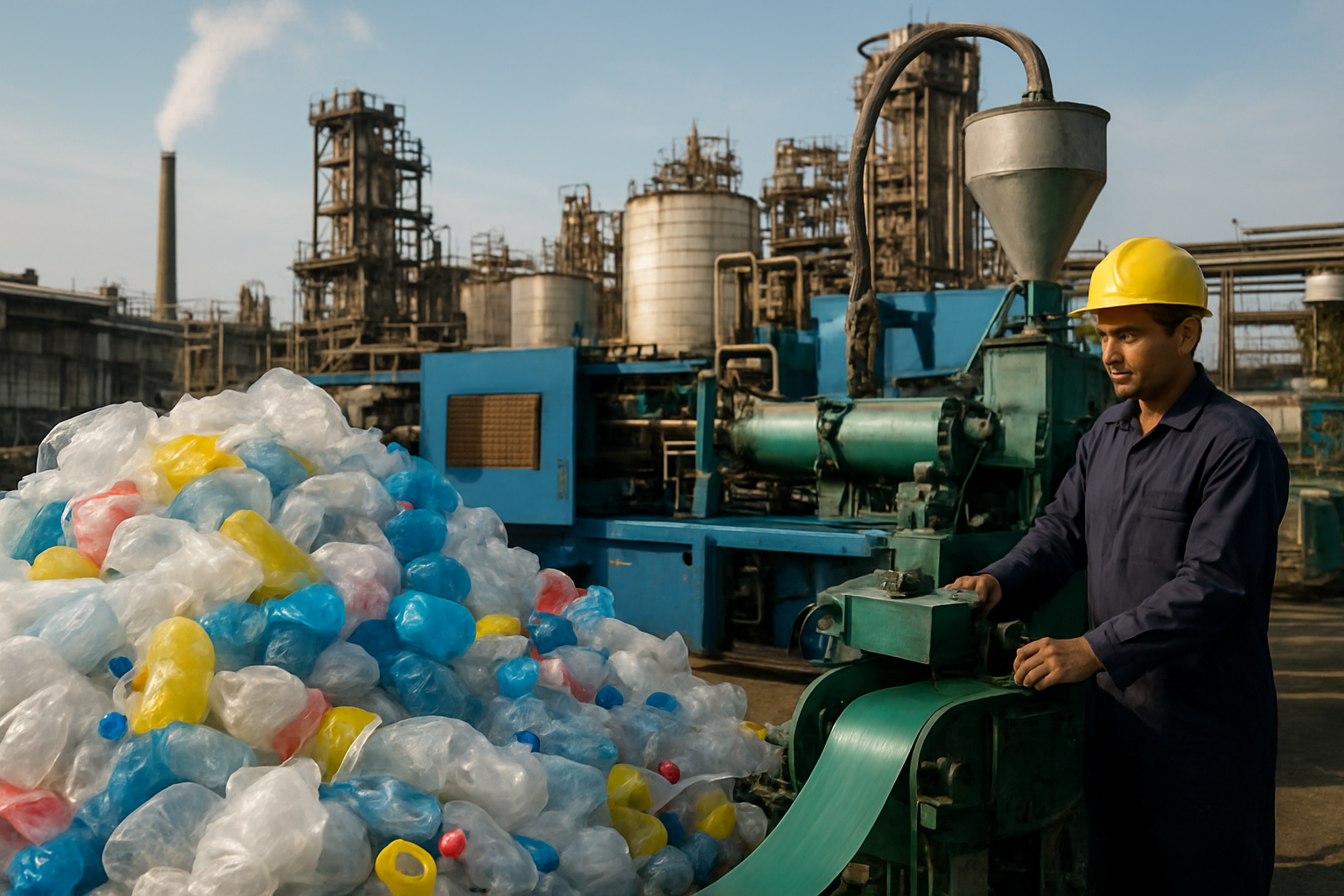
Ask most people to name the industries driving Bangladesh’s economy and they will say garments, then pause. Plastics rarely makes the list. Yet it sits underneath almost every other sector on it — supplying the hangers and packaging that garments ship in, the bottles and blisters pharmaceuticals depend on, the pipes construction runs through, and the crates agriculture moves produce in.
It is a quiet industry with an outsized structural role. Here is what it actually contributes.
The Scale of the Sector
Bangladesh hosts more than 6,000 plastic manufacturing units, with roughly 80% of them small and medium enterprises and around 450 export-oriented firms. The sector employs approximately 1.5 million workers and serves a domestic market valued near USD 3 billion, meeting over 80% of local demand and cutting dependence on imported plastic goods.
Growth has been consistent, estimated at around 20% annually, with export growth reaching roughly 21% in FY25. About 17% of output is exported — a share that has been rising as manufacturers pursue diversification beyond the domestic market.
The product range is wide: more than 2,500 product types spanning packaging, household goods, furniture, toys, melamine, PP woven bags, garment accessories, construction materials, and components for electrical and automotive applications.
Backward Linkage: The Sector’s Real Contribution
The plastics industry’s most important economic function is not its own export figure. It is the support it provides to other export sectors.
Ready-made garments. Every garment shipment leaves Bangladesh with plastic hangers, polybags, buttons, zip pullers, tags, and cartons’ worth of protective film. Domestic production of these accessories means RMG exporters source locally instead of importing, shortening lead times and retaining value inside the country. The largest domestic producers manufacture hangers in the millions per day.
Pharmaceuticals. Bangladesh’s pharmaceutical sector, one of its strongest export stories, depends on locally produced bottles, closures, blister films, vials, and containers meeting pharmaceutical-grade standards.
Agriculture and food processing. Crates, storage containers, irrigation pipes, mulch films, and packaging for processed food all come from domestic plastic manufacturers. Reduced post-harvest loss is directly linked to better handling and storage materials.
Construction. PVC pipes and fittings, cable conduit, water tanks, and sanitary ware support a construction sector expanding with urbanisation and infrastructure investment.
Electronics and light engineering. Housings, switch components, connectors, and moulded parts feed a growing domestic assembly base.
When an economist counts the plastics industry’s contribution as its own value added alone, the count is incomplete. The sector functions as infrastructure.
Employment and the SME Base
With around 1.5 million workers and an SME-heavy structure, plastics is an employment-intensive sector that spreads work beyond the major industrial corridors. Small moulding units, recycling operations, printing and converting workshops, and distribution networks reach across the country.
Competitive labour costs have historically supported the industry’s cost position. Sustaining that advantage now depends on productivity and skill rather than wages alone — an industry-wide recognition that has pushed attention toward technical training in mould design, machine operation, process control, and quality management.
Where the Constraints Lie
The sector’s growth story comes with genuine structural challenges.
Raw material dependence. Bangladesh imports nearly all its polymer feedstock — PE, PP, PVC, PET, PS. That leaves manufacturers exposed to international price swings, currency movement, freight disruption, and port delays. Regional supply chain shocks have repeatedly hit production schedules and forced factories to cut output.
Energy reliability. Moulding and extrusion are continuous processes. Power interruption does not just pause production; it can scrap an entire batch and require a full restart cycle.
Technology gap. A meaningful share of installed machinery is older-generation hydraulic equipment, less energy-efficient and less precise than current servo and all-electric alternatives. Upgrading requires capital that many SMEs struggle to access.
Waste management and environmental perception. Plastic waste in urban drainage and waterways shapes public opinion about the industry as a whole, regardless of who produced or discarded the material. Building visible, credible recycling and collection infrastructure is both an environmental necessity and a reputational one.
Skills and standards. Meeting international buyer requirements demands documented quality systems, compliance testing, and traceability — capabilities that are uneven across the SME base.
Policy Direction and Export Ambition
Government attention to the sector has increased, with a plastic industry policy including long-term tax incentives for entrepreneurs and recognition of plastics as an export diversification priority. Industry associations — BPGMEA and related bodies — have set ambitious export targets, and foreign machinery suppliers report growing demand from Bangladeshi manufacturers for injection moulding equipment, PP woven bag lines, PET blow moulding machines, and flexographic printing units.
That equipment demand is a useful signal. Factories investing in modern capacity are positioning for export orders, not just domestic replacement.
What Growth Requires Next
Three shifts would meaningfully change the sector’s trajectory.
Move up the value chain. Commodity household goods compete on price alone. Engineering components, medical-grade products, precision automotive parts, and technical packaging command better margins and are harder to displace.
Build genuine circularity. Domestic recycling capacity, PET flake and granule production, and reliable recycled feedstock reduce import dependence while addressing the waste problem. This turns a liability into a supply advantage.
Invest in compliance capability. Export buyers increasingly require documented material compliance, restricted-substance testing, environmental certification, and social audit readiness. Factories that build these systems access markets that others cannot.
The View From the Factory Floor
For manufacturers like FH Plastics Industry, these national figures translate into practical decisions: which grades to specify, which certifications to pursue, which capacity to add, and which customers to serve. The sector’s growth is not an abstraction — it is the sum of thousands of individual factories choosing to build capability rather than just capacity.
Frequently Asked Questions
How much does Bangladesh export in plastic products?
Exports have grown substantially, with roughly 17% of sector output now exported and export growth around 21% in FY25. Garment accessories and PP woven bags are major categories.
Does Bangladesh produce its own plastic raw materials?
Largely no. Polymer resins are predominantly imported, which is the sector’s most significant structural vulnerability.
What is the largest plastic product category in Bangladesh?
Packaging and household goods dominate by volume, with garment accessories representing a major export-linked segment.
Conclusion
The plastic industry in Bangladesh is not simply another manufacturing sector — it is the connective material underneath several others. Its future depends less on volume growth than on moving toward higher-value products, cleaner processes, and the documented quality standards that international buyers now treat as a starting requirement rather than a bonus.


Related Posts

Uncategorized
How FH Plastics Ensures Durable, Safe Products
How FH Plastics Ensures Durable, Safe Products Durability and safety are…

Uncategorized
5 Ways Plastic Manufacturing Is Going Green in 2026
For years, “green plastics” was mostly a marketing line. In 2026…

Uncategorized
Recyclable vs Non-Recyclable Plastics: What Manufacturers Need to Know
Not all plastic is created equal. Two containers that look identical…

Uncategorized
The Future of Plastics Manufacturing in South Asia
South Asia has spent two decades building plastics manufacturing capacity. The…


