





































Behind the Machines: A Day at FH Plastics Industry

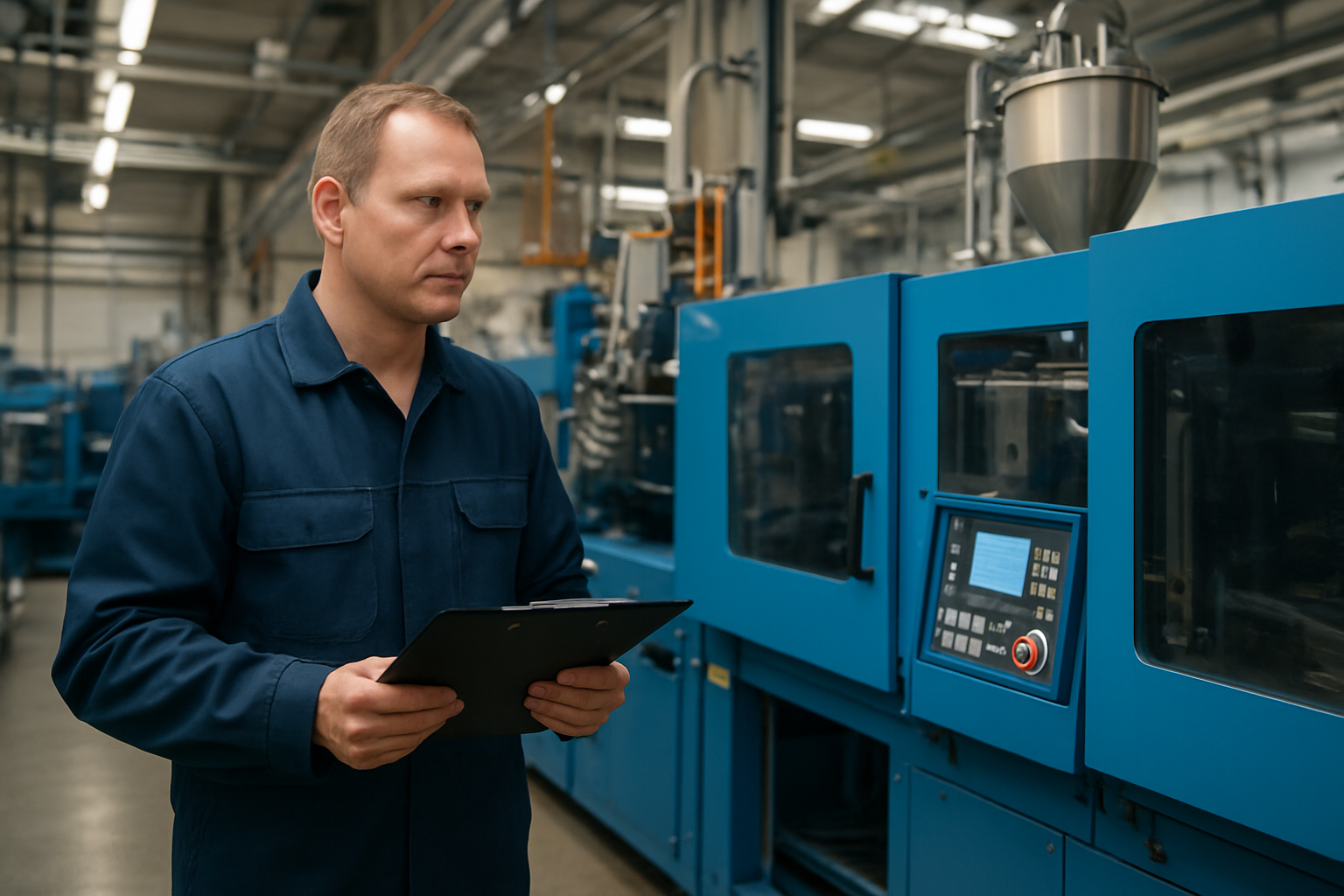
Most people encounter plastic products only at the end of the journey — on a shelf, in a warehouse, on a delivery truck. The part they never see is the eight or sixteen or twenty-four hours of controlled, repetitive precision that produced them.
This is what a working day looks like inside FH Plastics Industry.
06:00 — Shift Handover and Line Startup
The day does not begin with machines. It begins with a conversation.
The outgoing shift briefs the incoming one: which machines ran clean, which one showed a temperature drift around midnight, which tool is due for maintenance, which order is running behind and which is ahead. Production logs pass across along with the notes that never make it into a log — the operator’s sense that a particular mould is starting to flash slightly at the parting line.
Then startup. Machines that have been idle need heat soak time; barrel and mould temperatures must reach setpoint and stabilise before the first shot. Rushing this produces short shots, sink marks, and a bin of scrap. Experienced operators do not rush it.
Cooling water circuits are checked for flow and temperature. Compressed air pressure is verified. Safety guards and interlocks are tested — a machine that closes with several tonnes of clamp force does not forgive a bypassed guard.
07:00 — Material Preparation
The material store is quieter than the production hall and just as important. Resin arrives in sacks and bags, each with a lot number tied to a supplier certificate. Nothing moves to the floor without that documentation matching.
Hygroscopic materials go to the dryers first. Polymers that have absorbed atmospheric moisture will produce parts with splay marks, internal voids, and reduced strength — defects that are invisible in a quick visual check and expensive when they reach a customer. Drying time and dew point are set by material grade, not by convenience.
Colour masterbatch is weighed and dosed to specification. Where in-house regrind is used, it is blended at validated ratios and only in applications where it has been qualified. The blend record goes into the batch file.
08:00 — First Article and Production Release
Before a run is released, the first parts off the tool are inspected properly. Not glanced at — measured.
Weight is checked against the standard. Critical dimensions are verified with calipers and gauges. The part is examined for flash, short shots, sink marks, weld lines, warpage, and surface finish. If the tool has multiple cavities, parts from each cavity are checked separately, because a single blocked cooling channel can make one cavity behave differently from the rest.
Only when the first article passes does the run go into production. This step takes minutes. Skipping it can cost thousands of parts.
09:00–13:00 — The Rhythm of Production
The production hall settles into cadence. Machines cycle: clamp, inject, hold, cool, open, eject. Robots or operators remove parts, and the cycle repeats — thousands of times, each one required to be identical to the last.
Operators are watching for the small signals that precede problems. A cycle time creeping upward suggests a cooling issue. Increasing flash points to tool wear or clamp force drift. A change in part weight means process drift. A subtle colour shift means dosing variance.
Process technicians move between machines, reviewing parameter screens against the validated settings. The rule is consistent: settings are not adjusted to mask a symptom. If a process moves outside its window, the cause is investigated.
In-process sampling runs to a schedule. Parts are pulled at defined intervals, measured, and recorded. The data builds a picture over the shift — trends visible long before a tolerance is breached.
Meanwhile the tool room handles maintenance on moulds not currently in production: cleaning, vent inspection, ejector pin servicing, cooling channel flushing. A well-maintained tool runs faster and produces better parts, and tool maintenance done on schedule is far cheaper than tool repair done under pressure.
13:00 — Quality Laboratory
Away from the noise, samples from the morning’s production go through more rigorous checks.
Depending on the product family: drop testing at ambient and reduced temperature, stack load testing held over time to reveal creep, hinge cycling for closures, dimensional inspection against drawings, and material verification tests. Results are logged against the batch code.
For products with food-contact or regulated applications, the documentation is as important as the test. Material declarations, compliance certificates, and traceability records are assembled into the batch file that follows the shipment.
14:00–18:00 — Finishing, Assembly, and Packing
Moulding is rarely the last step. Parts move to secondary operations — trimming, deburring, printing, labelling, assembly of multi-component products, and functional testing where required.
Packing is its own discipline. Count accuracy, carton condition, labelling, batch code visibility, and stacking pattern all matter, because a perfectly made product damaged in transit is indistinguishable from a badly made one when it reaches the customer.
Runners, sprues, and rejected parts are collected and segregated by material type. Mixed scrap is worth little; segregated single-polymer scrap goes back into the granulator and returns to production as usable material. This is where a factory’s waste rate turns into either a cost or a recovery.
18:00 — Records, Dispatch, and Handover
Production quantities are reconciled against the plan. Scrap is weighed and recorded by cause, not just by weight — knowing that a shift produced 40kg of scrap is less useful than knowing 30kg of it came from one tool’s flash problem.
Dispatch documentation is prepared, batch codes cross-checked against inspection records, and the handover to the next shift begins with the same conversation that opened the day.
What the Day Reveals
Nothing about a well-run production day is dramatic. That is the point. Consistency is produced by unglamorous discipline — heat soak times honoured, first articles measured, samples pulled on schedule, scrap segregated, records completed.
The parts that leave FH Plastics Industry look simple. What makes them dependable is that the thousandth one is the same as the first.


Related Posts

Uncategorized
How FH Plastics Ensures Durable, Safe Products
How FH Plastics Ensures Durable, Safe Products Durability and safety are…

Uncategorized
5 Ways Plastic Manufacturing Is Going Green in 2026
For years, “green plastics” was mostly a marketing line. In 2026…

Uncategorized
Recyclable vs Non-Recyclable Plastics: What Manufacturers Need to Know
Not all plastic is created equal. Two containers that look identical…

Uncategorized
The Future of Plastics Manufacturing in South Asia
South Asia has spent two decades building plastics manufacturing capacity. The…


