





































Why Quality Plastic Components Matter in Manufacturing

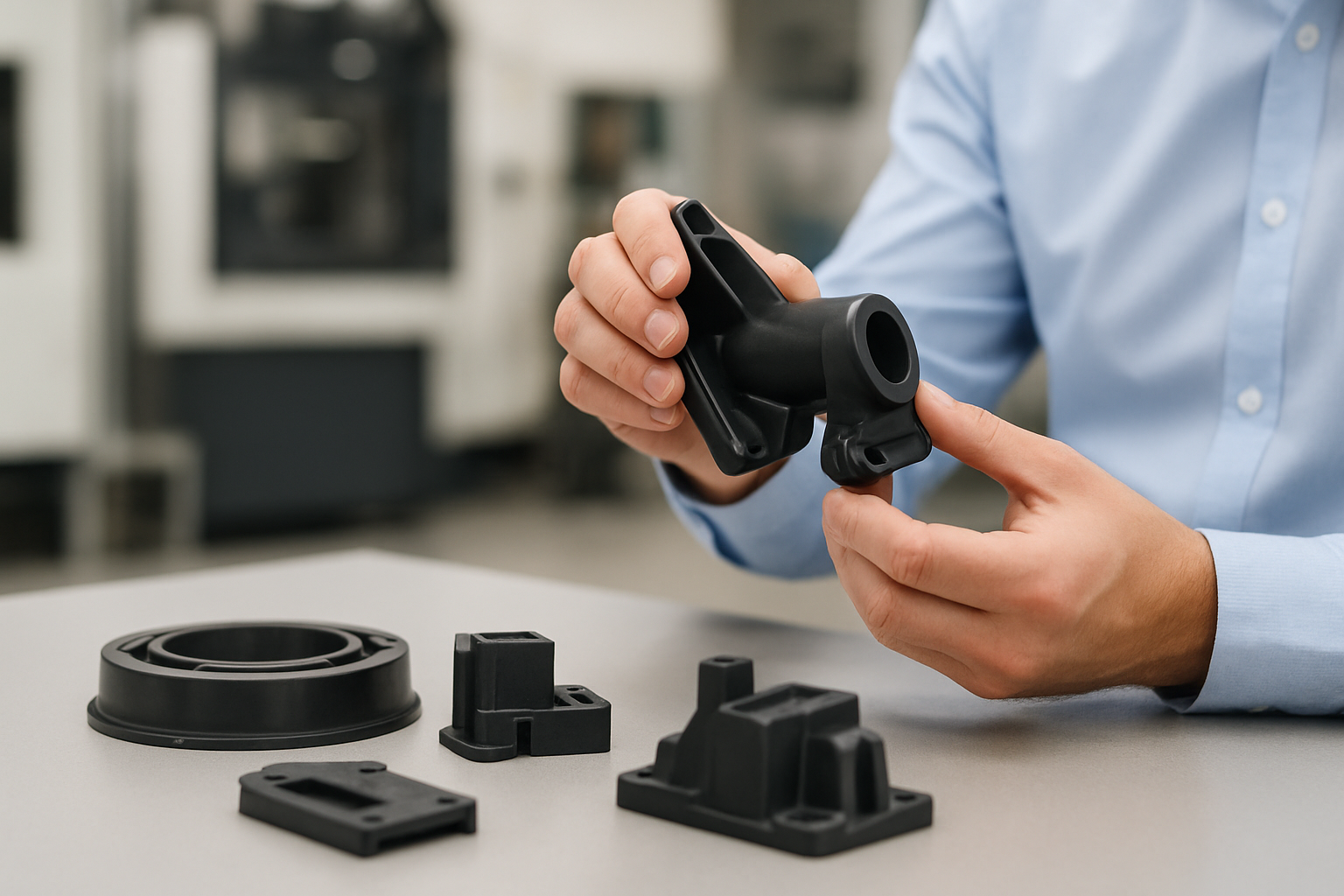
A plastic component is usually one of the cheapest items on a bill of materials. It is also, disproportionately often, the reason an assembly line stops.
That asymmetry is the whole argument. The purchase price of a component tells you almost nothing about what it will cost you. What matters is whether it fits, holds, seals, and survives — every time, without exception.
The Real Cost of a Cheap Part
Consider what happens when a moulded bracket arrives 0.4mm out of tolerance.
Assembly operators notice parts binding. Line speed drops. Some units go through with excess force, creating stress that will fail later in the field. Quality flags an issue; engineering investigates; a batch is quarantined. Production is rescheduled. The supplier is contacted, a replacement batch is expedited at premium freight, and the shipment date slips.
Weeks later, warranty claims begin appearing from the units that were forced through.
None of that cost appears on the purchase order. All of it is real. Studies of manufacturing cost of poor quality consistently find that the downstream cost of a defective component exceeds its purchase price by an order of magnitude or more — and that multiplier grows the further into the process the defect travels. A defect caught at incoming inspection is cheap. The same defect caught by a customer is not.
What Actually Defines Component Quality
“Quality” is a vague word. In moulded components it breaks into specific, measurable attributes.
Dimensional accuracy and repeatability. A part must hold tolerance not once but across every cavity, every shift, and every batch. Repeatability is what makes automated assembly possible.
Material integrity. The correct polymer grade, with the specified additive package, processed without moisture-induced degradation. A visually perfect part made from over-dried or contaminated resin can be mechanically compromised.
Freedom from internal stress. Uneven cooling locks stress into a part. It may pass inspection and then warp in storage or crack weeks into service. Consistent wall thickness and controlled cooling prevent it.
Surface finish and cosmetic consistency. For visible components, colour matching, gloss level, and absence of sink marks, flow lines, and flash determine acceptance.
Functional performance. Snap fits that engage with the right force, threads that seat, seals that hold pressure, hinges that survive their rated cycle count.
Consistency of the above over time. This is the attribute buyers underestimate most. A supplier who delivers excellent samples and mediocre production is worse than one who delivers consistent, adequate parts.
Where Component Quality Comes From
Quality is produced upstream, not inspected in at the end.
Tooling. A precision mould with proper cooling layout, adequate venting, balanced runners, and correct steel selection produces good parts almost by default. A poorly built tool fights the process forever. Tooling is where quality is decided, and where cost-cutting causes the most lasting damage.
Material specification. Grade selection matched to the application’s load, temperature, chemical exposure, and service life — verified on arrival rather than assumed from the invoice.
Process validation. Establishing the process window through structured trials rather than operator intuition, then locking parameters and monitoring for drift.
Measurement capability. A supplier cannot control what it cannot measure. Calibrated instruments, defined inspection plans, and recorded data are the minimum.
Maintenance discipline. Tool wear is gradual and quality degrades with it. Scheduled maintenance prevents the slow slide that nobody notices until a customer does.
Evaluating a Component Supplier
When qualifying a plastic component manufacturer, the useful questions go past capability statements.
- Can you show first article inspection reports and dimensional data for a recent production run? Data, not claims.
- What is your process for handling a non-conformance? Look for containment, root cause analysis, and corrective action — not just replacement.
- How are your tools maintained, and who owns them? Tool ownership and maintenance responsibility should be explicit in the contract.
- What is your scrap rate, and what are the top three causes? A supplier who knows the answer is measuring; one who does not, is not.
- Can you trace a finished part back to its resin lot, machine, and shift? Traceability determines whether a future problem can be contained or must be absorbed.
- What is your capacity headroom? A supplier running at full capacity has no room to recover from a problem.
- Do you have documented compliance for the materials in my application? Especially for food contact, potable water, medical, or children’s products.
Site visits reveal what documents cannot: whether the material store is organised, whether the tool room is maintained, whether inspection stations are actually being used, and whether operators can explain what they are checking and why.
Total Cost of Ownership, Not Unit Price
The correct comparison between suppliers includes:
| Cost element | Cheap supplier | Quality supplier |
|---|---|---|
| Unit price | Lower | Slightly higher |
| Incoming inspection burden | High | Low |
| Assembly line disruption | Frequent | Rare |
| Rework and scrap at your plant | Significant | Minimal |
| Warranty and field failures | Elevated | Low |
| Engineering time spent on supplier issues | Substantial | Minimal |
| Schedule reliability | Uncertain | Predictable |
The unit price difference is usually a few percent. The total cost difference is frequently much larger — and moves in the opposite direction.
The FH Plastics Approach
FH Plastics Industry treats component quality as a process outcome rather than an inspection result. Validated materials, maintained tooling, locked process parameters, in-process measurement, and full batch traceability produce parts that behave the same way in the thousandth shipment as in the first.
For a customer, that predictability is the actual product. The component is just what it arrives in.
Frequently Asked Questions
What tolerance can injection moulding hold?
It depends on polymer, part geometry, and tool quality. General-purpose moulding typically holds tighter tolerances on smaller dimensions and shorter flow lengths; precision applications require tool design, material selection, and process control planned around the tolerance from the start.
Why do parts warp after production?
Almost always internal stress from uneven cooling or inconsistent wall thickness. It is a design and process issue, not a storage issue.
Should I use a cheaper supplier for non-critical parts?
Only if “non-critical” has been properly assessed. Many components labelled non-critical still stop an assembly line when they do not fit.


Related Posts

Uncategorized
How FH Plastics Ensures Durable, Safe Products
How FH Plastics Ensures Durable, Safe Products Durability and safety are…

Uncategorized
5 Ways Plastic Manufacturing Is Going Green in 2026
For years, “green plastics” was mostly a marketing line. In 2026…

Uncategorized
Recyclable vs Non-Recyclable Plastics: What Manufacturers Need to Know
Not all plastic is created equal. Two containers that look identical…

Uncategorized
The Future of Plastics Manufacturing in South Asia
South Asia has spent two decades building plastics manufacturing capacity. The…


