





































Innovations in Industrial Plastic Solutions for 2026

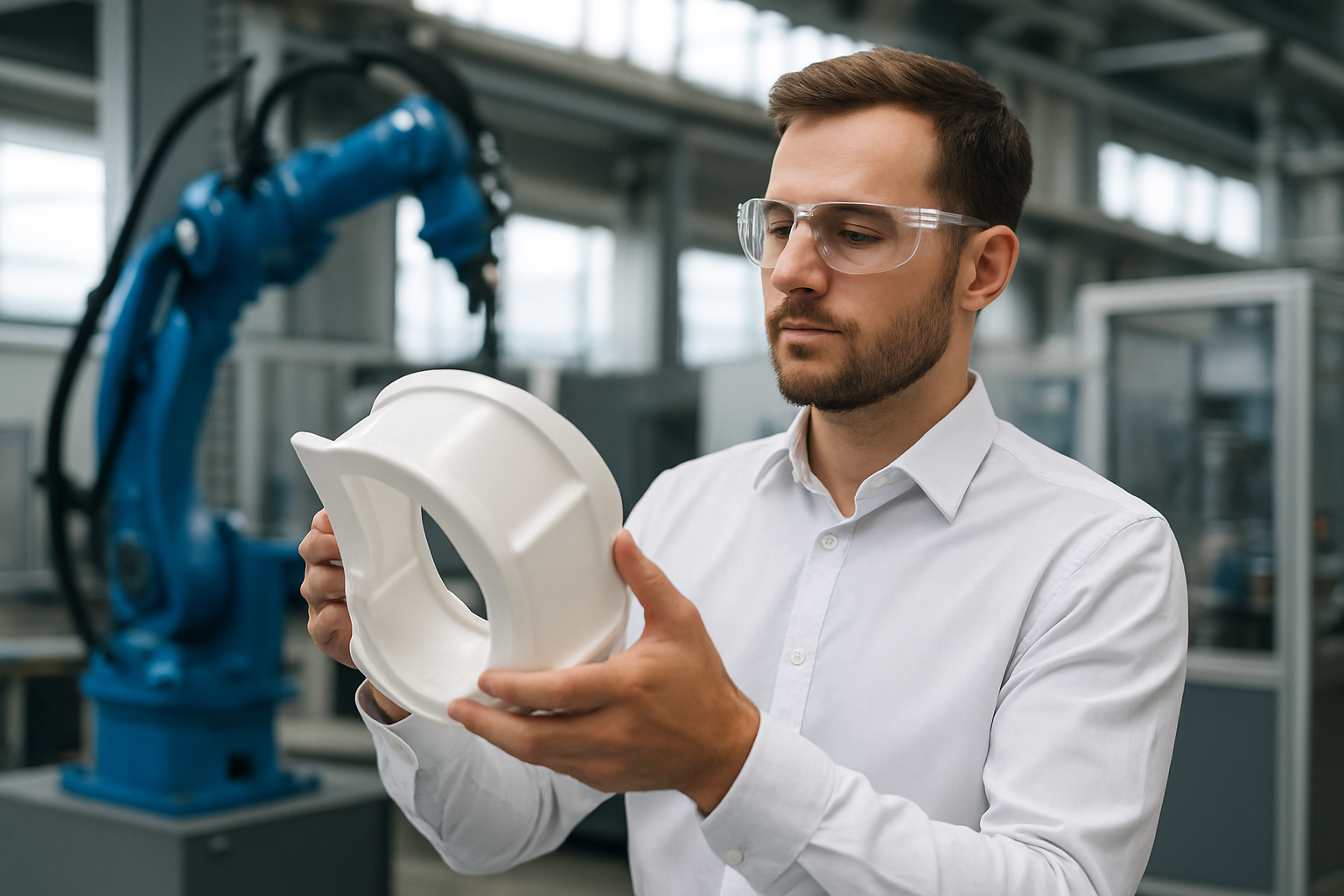
Industrial plastics rarely make headlines. The innovation happens quietly — in a slightly faster cycle time, a component that replaces a metal one at a third of the weight, a sensor that catches process drift before it becomes scrap.
Collectively, these changes are reshaping what industrial plastic solutions can deliver. Here are the developments worth attention in 2026.
1. Sensor-Driven Moulding and Real-Time Process Control
The most consequential shift in moulding is the move from parameter-based control to condition-based control.
Traditional moulding sets machine parameters — injection pressure, hold time, temperature — and assumes the resulting part is correct. Cavity pressure sensors change that by measuring what actually happens inside the mould during each shot. The pressure curve inside the cavity is a direct signature of part quality, and deviations show up immediately.
This enables genuinely useful capabilities:
- Automatic shot-by-shot rejection of parts whose pressure profile falls outside the validated envelope
- Early detection of tool wear, blocked cooling channels, or material variation before they produce visible defects
- Reduced inspection burden, since process data provides evidence of conformance
- Faster process setup when changing tools or material lots
Combined with machine monitoring platforms that track OEE, cycle time, and downtime causes across a plant, manufacturers gain visibility that was previously reconstructed after the fact from scrap bins and shift notes.
2. Conformal Cooling and Additive-Manufactured Tooling
Cooling determines cycle time, and cycle time determines cost. Conventional mould cooling uses straight-drilled channels, which cannot follow complex part geometry — leaving hot spots that slow the cycle and build internal stress.
Additively manufactured mould inserts allow cooling channels to follow the contour of the part. The results reported across the industry are substantial: shorter cycle times, more uniform cooling, less warpage, and better dimensional stability.
Additive manufacturing is also changing prototype and bridge tooling. Printed inserts allow a design to be validated in production material before committing to hardened steel — reducing the risk of expensive tool modifications late in a programme.
3. High-Performance Polymers Replacing Metal
Metal replacement continues to expand into applications that would have been unthinkable a decade ago. Engineering and high-performance polymers now serve in bearings, bushings, gears, pump housings, valve bodies, and structural brackets.
The advantages compound: lower weight, corrosion resistance, self-lubrication in some polymer families, vibration damping, electrical insulation, and elimination of secondary machining and coating operations. Glass and carbon fibre reinforcement extends the load range considerably.
Where this matters most in industrial settings:
Chemical processing — polymer components resist corrosive media that attack metals
Food and beverage — non-corroding, washdown-tolerant, and compliant with contact requirements
Material handling — lightweight wear components with low friction and quiet operation
Water and irrigation — polymer fittings and valve bodies that do not scale or corrode
Electrical infrastructure — insulating housings and enclosures with flame-retardant grades
The design discipline is different from metal. Polymers creep under sustained load, expand more with temperature, and have anisotropic properties influenced by flow direction. Successful metal replacement designs around these characteristics rather than substituting material into a metal geometry.
4. Circular Material Systems Built Into Production
Recycled content has moved from a sustainability initiative to a supply chain strategy. The innovation is less in the recycling itself than in the systems that make recycled material dependable.
Closed-loop industrial programmes where returnable crates, pallets, and containers are collected at end of life and reprocessed into new production — a controlled feedstock with known material history.
In-line regrind with process integration where sprues and runners are granulated and returned to the hopper at validated ratios, monitored rather than assumed.
Material characterisation on intake — melt flow index, moisture, contamination screening — turning variable recycled feedstock into a specified input.
Chemical recycling, still developing commercially, offering a route to near-virgin quality material from mixed and contaminated waste streams that mechanical recycling cannot process.
5. Simulation and Digital Twins Before Steel Is Cut
Mould flow simulation is not new, but its scope has expanded. Current tools model fill, pack, cool, warp, fibre orientation, and residual stress with enough accuracy that design decisions are made in software rather than discovered in trial.
The practical payoff is fewer tool modifications. Gate location, runner balance, cooling layout, and wall thickness distribution are optimised before a mould is manufactured — which is the only stage where changes are inexpensive.
Digital twin approaches extend this to the running process, comparing live production data against the simulated model to identify where reality is diverging from prediction.
6. Automation Beyond Part Removal
Robotics in moulding has moved past simple take-out. Current cells perform in-mould labelling, insert loading, assembly of multi-component products, vision-based inspection, and automated packing.
Vision systems deserve particular mention. Camera-based inspection integrated into the cell can check dimensions, surface defects, colour, and presence of features on every single part rather than on a sample — at line speed, without operator fatigue.
For manufacturers in cost-competitive markets, automation is less about replacing labour than about achieving consistency and freeing skilled operators for process work that genuinely requires judgement.
7. Smarter Additives and Functional Surfaces
Material science continues to add capability without changing the base polymer:
- Antimicrobial additives for healthcare, food handling, and high-touch surfaces
- Advanced UV stabiliser packages extending outdoor service life
- Conductive and anti-static compounds for electronics handling and explosive-atmosphere environments
- Flame-retardant systems meeting current standards without restricted substances
- Detectable pigments replacing carbon black so dark parts remain sortable at end of life
What This Means for Industrial Buyers
The practical implication is that specifications written five years ago may be leaving performance on the table. Applications previously ruled out for polymer components may now be viable. Cycle times accepted as fixed may be reducible. Inspection regimes built around sampling may be replaceable with process evidence.
A conversation with a capable manufacturer about a long-standing component often surfaces options that did not exist when the part was designed.
Innovation With a Purpose
At FH Plastics Industry, technology adoption is evaluated against a simple test: does it make the product more consistent, more durable, or more efficient to produce? Innovation that does not reach the finished part is a press release, not a capability.
Looking Forward
Industrial plastic solutions in 2026 are defined by convergence — better data, better tooling, better materials, and better recovery systems arriving together. The manufacturers who integrate them will produce parts that are lighter, more consistent, and more sustainable than what the same factory produced three years ago, using less energy to do it.



Related Posts

Uncategorized
How FH Plastics Ensures Durable, Safe Products
How FH Plastics Ensures Durable, Safe Products Durability and safety are…

Uncategorized
5 Ways Plastic Manufacturing Is Going Green in 2026
For years, “green plastics” was mostly a marketing line. In 2026…

Uncategorized
Recyclable vs Non-Recyclable Plastics: What Manufacturers Need to Know
Not all plastic is created equal. Two containers that look identical…

Uncategorized
The Future of Plastics Manufacturing in South Asia
South Asia has spent two decades building plastics manufacturing capacity. The…


